
Our Archive

Blog Archives

Dropinceo > Blog >

One of the biggest frustrations I see in a corporate setting is when great work never gets implemented fully because of poor change management. New and innovative ideas are often overlooked because we rarely give our subject matter experts the framework to socializing their proposal to get buy-in. This is the pain point we need to address to evolve the capability of our experts. 

I call this the SME Conundrum; the Subject Matter Expert who is celebrated for their expertise, but then falls short because we’ve never developed them beyond their area of expertise. They have gotten ahead because of their expertise, but no one has taught them how to socialize to get buy-in and move it forward. This is often necessary in a cross-functional environment and tiers of stakeholders who need to be consulted. When we don’t develop these skills in our SMEs, they lose their confidence and become a quiet contributor vs. your next stand out C-Suite Leader. 

The Framework to Socialize a Proposal for Buy-In

In a large corporation, I was required to cascade a new initiative through our plant managers and I knew it would be an uphill battle. With so many initiatives happening at once, how was I going to layer on another? Instead of facing glazed eyes and courteous deflection I positioned it in a way that used their language, their pain points and how they could benefit from the work. Once they understood the potential value along with my commitment to partner with them, they soon provided feedback on how it could work. With an evolved framework that made sense to them, I shared it with our senior leadership committee and was able to get it through. The success came because I had socialized in advance with either an advocate (or critic) to evolve how it could work.

Often, when new ideas are presented, leaders may deflect or simply defer because no one wants to go first in approving it. With an advocate in the room who can speak to the benefit, silence or deflection becomes constructive conversation. It then evolves from there and even if there are gaps still to be closed you are seen, heard and respected for facilitating constructive dialog.

In the end, I was able to move the initiative through all the plants. But, it took hard work, not because of the technical details of the initiative. Implementation comes easy. It is the socialization of meeting with stakeholders in advance that is the hard work; but necessary to have a smoother and faster implementation.

Sounds easy? Well, it can be with a framework for which I’m providing a simple tip sheet below: 
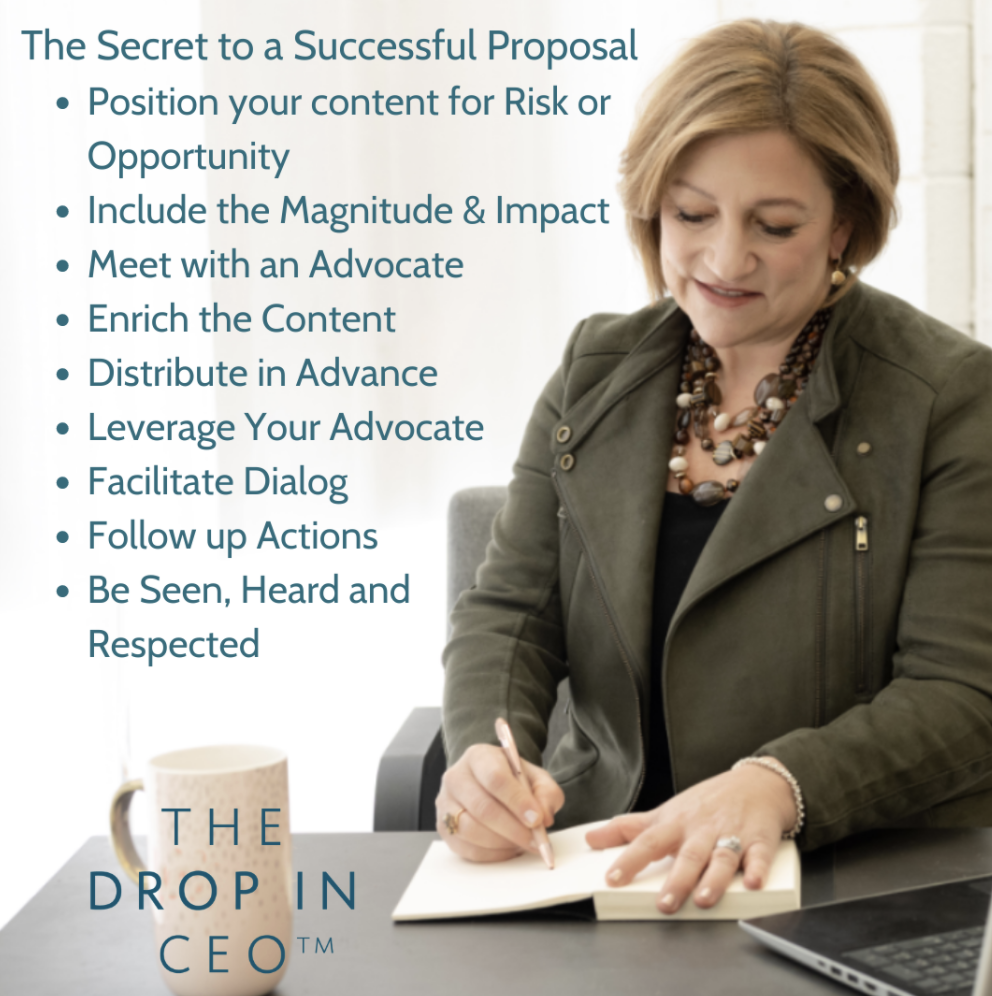
No alt text provided for this image

To hear the rest of the story and details around this process, listen to my upcoming podcast episode which airs Friday April 1st. Here you will hear more of my secrets to a successful proposal.

  • Do you have the skills to try this on your next proposal? 
  • Do you know someone on your team or in other areas of the business that can benefit from learning these tips to be more effective as a leader?
  • Would you like to talk to someone about these challenges and glean a few more tips? 

I offer a 30 minute complimentary consultation to discuss your unique situation because I simply want to help you and others struggle less. I want everyone who is aware they need to try something new to struggle less and achieve their career goals. 

For more information about The Drop In C-Suite Academy (CS)  dedicated to the aspiring C-Suite leader, simply register to get on the waitlistemail me or connect with me for a quick chat. I can’t wait to help you be successful and reach your goals!

For more resources, you can listen to The Drop In CEO Podcast or check out my book The CEO’s Compass will help you get on track in days not months. 

No alt text provided for this image

Resources

Good Reads

Courageous Cultures: How to Build Teams of Micro-Innovators, Problem Solvers, and Customer Advocates by Karin Hurt. Karin was my podcast guest this week and her unique perspective to change how you approach problems and move teams is amazing. Please check out her book and also our podcast interview this week to learn more. 

Good Music

Soundcritters – Heroic Opportunities – I do hope you listen to this piece if you are an aspiring C-Suite leader who has the right mindset and is seeking the path towards that goal. This is very inspirational as it pushes you forward once you have set your mind to invest in yourself and personal development. 

Good Advice

So often we wish our bosses could be different. We often wish to achieve the next level; you’re a supervisor and want to be a manager. However, you can be the person now. You can be who you would want your boss to be. The only thing holding you back is yourself. Start being the boss you want to be remembered by and soon people will gravitate towards you because you are becoming a leader. When you behave like a leader, you become that leader. The title is simply the recognition. 

 “Be the leader you want your boss to be.” 

–Karin Hurt

Listen and subscribe now

Read More

Ten years ago, I didn’t have a clue what it meant to have a “presence.” I’d show up, give my stellar presentations and then there was simply crickets. No questions, no dialog and I would return to my desk and continue the work I was paid to do. 

Everything changed when I started my own business and realized how presence impacts decision making.

Through trial and error I began to receive feedback at networking events about my message and my “presence.” I followed the breadcrumbs and made connections between what people were saying and what I was doing which was incredibly time consuming, but worth it. I often wondered what a playbook for executive presence would look like.

While I don’t have all the answers, I’ve distilled my process into a three part formula:

  • Foundation
  • Physical
  • Messaging

Foundation

You need to have a well defined “pitch” about who you are, what do you do and what problem you solve. We want people to remember you for this and practice it over and over again. Write it down. Now practice delivering it as a:

  • 10 second pitch
  • 30 second pitch
  • 3 minute detailed pitch

This is the way conversations start so people get to know you. You will learn when the 10 second, 30 second or 3 minutes are relevant so that people know you and want to learn more about you.

When it comes to a presentation, you always go to your foundation and as an example:

  • Today we are here to discuss the inefficiencies we see in our operations. It’s important to maximize our assets, leverage our resources and be best in class. Through the expertise of my organization, we approach this challenge and apply analytical rigor to find the best solution. 

Always use those talking points: maximize our assets, leverage our resources and be best in class. Soon you will be known to be “that person” to go to for help in that area. 

Physical

There are a few key traits of physical presence that can help attract the right kind of attention when you walk into a room:

  • Confidence – show up as confident, even if you’re shaking in your shoes! Find something or someone to ground you and show up confidence. 
  • Technical Competence – know your stuff. Non-negotiable. Practice with a colleague or practice in a mirror. 
  • Strong Posture -whether sitting or standing you need to find your superman or super woman posture that makes you feel incredible. 
  • Voice – deliver with conviction, conciseness and confidence. I’ve often seen women or men when delivering content always end their sentence with an up-tilt note. This infuses doubt into the listener’s ear for which I suggest you practice ending sentences on a down note. I have some great resources for you on how to practice this skill
  • Appearance:  I hesitate to mention this because it’s not about a new hairdo or a new wardrobe. It’s about wearing the clothes and accessories that communicate a confident image and aligned to your messaging. It sometimes takes an external perspective to fine tune how you look physically and what people actually see in you. 

Once you have these foundational elements in place, it’s now time to take your information or content and to socialize it for support. Make sure that the content you use to communicate information is in a relatable language, you tell the audience what’s in if for them, you qualify the risk & opportunity in quantifiable terms and you come with your own thoughts and proposals. 

This is the culmination of presence; to be seen, heard and respected. You will soon feel yourself being pulled “to the table” more and more; I can promise you.

So how do we bring this all home for you? Let’s review: 

1)     What do you stand for? What do you want to be known for?

2)     Do you physically in all ways convey the message you want to convey both in your voice, delivery and the image people see when I am present?

3)     Content is king, not just what you present, but how it is received by your audience.

When these are in alignment, your presence is seen and heard and I promise you will stand out and be respected.

If this makes sense, I’m pleased you can put this to action.

If you’re still wondering how to put this to action, I am offering you the C-Suite Academy as my offer to help aspiring c-suite leaders take control of their careers based on my 25+ years of experience of navigating the system and learning what it takes to get into the c-suite.

For more information about C-Suite Academy (CSA) dedicated to the aspiring C-Suite leader, simply register to get on the waitlistemail me or connect with me for a quick chat. I can’t wait to help you be successful and reach your goals!

For more resources, you can listen to The Drop In CEO Podcast or check out my book The CEO’s Compass will help you get on track in days not months. 

No alt text provided for this image

Resources

Good Reads

Speaking to Influence: Mastering Your Leadership Voice Paperback – April 16, 2019by Dr. Laura Sicola I love Laura’s work and she shared with me many tips to even evolve my communication skills 

Good Advice

“Most of the issues that we are experiencing throughout our lives are based on that dysfunctional disconnection between emotions and feelings.” 

–Dr. Kinga Mnich

Listen and subscribe now:

Read More

I remember last curling season we were facing the top team in our league. I felt challenged and exhilarated at the same time. I knew this team’s strategy and I knew if I played their strategy against them, I would narrow the number of points between our scores and avoid humiliation. What I didn’t expect was that we nearly beat them when we decided to change our strategy!

What would it look like if leaders changed their strategy when it came to change?

What if we shared the change with our team and rather than discussing why it is hard, instead use a SWOT assessment to understand our capability to navigate the change? The SWOT assessment (Strength, Weakness, Opportunities, Threats) is an amazing tool to distill what you are good at, starting at a place of strength and then identify risks and actions to close those gaps. 

At the game, I turned to my vice skip and said we were going to play a take-out game; which meant every shot my opponent placed in a scoring position, we hit their rock out of play. My vice skip at first was unsure because that was not our typical game. I convinced them that that if we played a different and more riskier strategy we would upset them and they would have to play a defensive game. With that self assurance, the vice skip went back to the rest of the team and told them the new strategy. While it wasn’t the game we normally play, it’s a game they were ready to play to get a different result. 

My team’s strength was a “can-do” attitude. Their weakness was that the take-out shot was not their best shot, but they were willing to push themselves to deliver on that request. Their opportunity was if we played a different game, we would at least reduce the number of points our opponent could score. And finally the threat was my mindset to deliver on a different strategy and would I have the confidence to lead. 

As leaders, we need to show confidence in the wake of change, share risks associated with the change, but also with enthusiasm that the team would grow together. Your leadership is not necessarily about the result, but taking your team through a process where they feel like they can trust you. That is your legacy and why we should grow to feel more confident in navigating change. 

It was the second to last shot of the game and the score was tied 7-7. The fans were quiet as they watched the top team close to a loss. The opposing team was also unusually quiet as they saw their winning streak possibly coming to an end.

As I took my last shot; a very challenging take-out on the edge of the 8 foot ring, I made it to lead 8-7. As I walked back to my vice-skip, we knew we had already won the game despite the score. The opposing team made their last shot and took out one of our stones and then placed a 2nd one in play giving them two points for a 9-8 win over us.

The result did not matter, but instead the team unified behind a challenging task and a change of strategy that win or lose, we were victorious!

You can be an inspiration to others by taking risks, building trust and achieving success: making change a process for growth. Remember:

  • Explain the change so they understand
  • Ensure any concern is addressed with empathy
  • Build Trust by embracing the strengths of the team and exuding confidence to navigate uncertainty. 

If this story inspires you; think about someone who could use The CEO’s Compass: Your Guide to Get Back on Track; that gives you actionable tools to gain results in days vs. months. This resource can be your compass or someone you know who is going through transformation and needs just a few minor changes to get major results.

You can find my book on Amazon or other favorite book outlets. My podcast The Drop in CEO is a free resource to gain insights and inspiration from industry leaders and elevate your career or business outcomes. 

To learn more about curling (I could talk about it for hours) or have a 15 minute chat, let’s book a call!

Resources

Good Reads

The CEO’s Compass: Your Guide to Get Back on Track by Deborah A. Coviello.

I would be remiss if I did not share this resource with you. I’m quite proud of it as well as the people who supported me. This resource picks up where the leadership books left off: giving you the tools to open up your mind and show you how to achieve results in days vs. weeks. I can’t wait to hear what you think of it and who you can hand the compass to, to leave your legacy. 

Good Music

Runner by Dustin O’Halloran

I’ve changed my tune as I actually like running and this is a piece that picked me up as I muscled through the first mile today and as I’m preparing to run another ½ marathon. It’s a daunting task, but I’m up for it. Enjoy this song. 

Good People

Rick Maurer: How to Help Your Team Embrace Change I was so inspired by what Rick said about change and resistance. When it comes to resisting change, it boils down to: a) I don’t understand it, b) I don’t like it, c) I don’t trust it or “you”… As leaders, we have to be mindful to address these concerns and show you care. Ultimately we must show respect to the human; the change is secondary. 

#ceo #theceoscompass #dropinceo

Read More