
Our Archive

Blog Archives

Dropinceo > Blog >

So often, we hustle and try to get the work done. We cover for people that are on vacation. We’re so busy trying to keep all the balls moving that we forget that we as leaders need time to pause and reflect. Are you feeling overwhelmed and unsure of your next steps in your career or business? Sometimes the most important thing you can do to move forward is taking breaks and zooming out to gain clarity and focus.

The hard truth is that if you fail to take breaks, circumstances may provide one for you. I never used to own up to this. I have been let go from jobs a handful of times, and I can tell you the time off was life changing for me. When I got away from the work at hand, I gained so much clarity. Each time I had to dust off my resume or pause to think about my guiding principles for the new opportunity that I was seeking, I gained so much insight. When you’re in a job and you’re zoomed in all the time, you don’t take the time to assess where you’re going. If you need to slow down or speed up or change course, it’s best to do it intentionally before life does it for you.  

I remember being let go from a job that I probably shouldn’t have taken to begin with, but the money was good. I soon realized that I would not pursue that line of work in the future because it did not feed my soul. And quite frankly, I was miserable. These breaks are so important, yet fail to take them intentionally. We would rather wait for life happens to us and reflect when we’re in crisis.

If you want to be intentional about your next break, I’ve created a simple framework to make the most of your time:

  • Ask your boss for feedback: Ask what you can start doing, stop doing, and change in order to be more successful in your current position.
  • Give actionable feedback: When sharing your observations with your team, make sure there are tangible outcomes for them to pursue. 
  • Identify your actions: Listen to feedback and choose 1 or 2 actions you can take in the next quarter and focus solely on those things.
  • Make those actions a habit: Once you’ve gone to all the effort of making a change, hold yourself accountable to make that change a habit for long-term success. Deb shares her personal experiences and provides a framework for setting intentions, assessing progress, and making changes. By focusing on one or two changes at a time, you can celebrate your progress and stay on course towards your goals.

In a world that values hustle and constant productivity, it’s easy to forget the importance of taking breaks and gaining clarity. It’s essential for leaders to reflect on their actions and make changes when necessary. So take a deep breath and zoom out. Your career or business will thank you for it.

If you are aspiring to the C-Suite, and tired of the hustle, are you ready to change how you work and implement these tips? 

If you are a business owner or C-Suite leader, are you ready to invest in your people and help them be successful? Their success is your success! 

Now is the time for you to collect your thoughts and take action. I want you to succeed and this framework can enable you to do it yourself. 

However, if you need more help, I’m here for you as the Drop In CEO, CEO whisperer or as a sounding board. 

To hear more about my story about framework, please tune into my podcast that is releasing this Friday 6/23/23. 

Maybe you simply need a support system to apply these new insights. I find leaders need a place to talk through the challenges and that’s why I created The Drop In CEO Collective, a forum for C-Suite leaders of today and tomorrow. To learn more about our next event you can visit our page and register. 

Would you rather have a quick 1-2-1 to discuss your specific challenge? Could The Drop In CEO be your support system? Direct Message me on LI or contact me via my website and let’s have a conversation. Until then, I wish you much success. 

Read More

Did I just say that? Did I dispel every belief you had about working harder to get ahead? I’ve learned the hard way that you can only get promoted so far with your technical capability and hard work and then you hit a wall and then you get frustrated. 

I’m even more frustrated when leaders in the C-Suite are not transparent about what to tell their staff why they cannot get ahead. Could it be you want to protect their resources? Or do they lack the skills to articulate feedback that will either help the employee or steer them in the right direction? 

Well, today is a new day and I’d like to share with you my experience and a framework that can help you to work smarter and get promoted faster. 

In a past role, I worked hard and I received 4 promotions in 7 years. That all came to an end when my advocate moved on and then I was stuck. I started shopping myself around within the company and no door would lead to where I wanted to go both career and financial. Instead I turned my energy outside and with that move to a new company, I was moved up again to 2 promotions in 4 years. This success happened by taking control of my career, networking with the right people and setting goals for myself.  I soon learned that hustle doesn’t always work but the way you work will get you ahead faster.

So let’s turn to you: How do we turn this into a framework that can work for you? 

5 Tips for working smarter, not harder towards your career goals

  • Advocates: are people who have your back and are always singing your praises. Lean into it, see how you can help, they are the ones that will promote or pull you ahead.
  •  Messaging: It’s not what you say, but how you say it – I teach this information vs. messaging; an essential skill you need. Contact me if you want to learn more, I talk about this as one of the highest missing skills for up and coming leaders
  • Talking points – aka executive presence. What are the 3-5 things you believe in and are your core values? Have stories to demonstrate them and be ready to showcase them in an interview or presentation. When you lead with talking points, you create consistency in your messaging and you become a trusted resource. 
  • Stakeholder management – when starting a project, know who the stakeholders are and make sure you have a relationship with them. Consider meeting regularly and when you have  your next initiative, float it to them for their input so when you position it, they’ve already bought into your idea.
  • Build an external network that is intentional. I regret not having done this while working within a company. I had 800 LI connections when I started and now I have 7500 and growing. With more eyeballs on you and your experience, the greater that there will be pull vs. the constant push.

If you are aspiring to the C-Suite, and tired of the hustle, are you ready to change how you work and implement these tips? 

If you are a business owner or C-Suite leader, are you ready to invest in your people and help them be successful? Their success is your success! 

Now is the time for you to collect your thoughts and take action. I want you to succeed and this framework can enable you to do it yourself. 

However, if you need more help, I’m here for you as the Drop In CEO, CEO whisperer or as a sounding board. 

To hear more about my story about framework,  please tune into my podcast that is releasing this Friday 6/16/23. 

Maybe you simply need a support system to apply these new insights. I find leaders need a place to talk through the challenges and that’s why I created The Drop In CEO Collective, a forum for C-Suite leaders of today and tomorrow. To learn more about our next event you can visit our page and register. 

Would you rather have a quick 1-2-1 to discuss your specific challenge? Could The Drop In CEO be your support system? Direct Message me on LI or contact me via my website and let’s have a conversation. Until then, I wish you much success.

Read More

The worst time to mitigate a crisis is when you’re in the middle of one. Leaders think their greatest purpose is to rush into battle with their teams to work tirelessly at all costs and celebrate surviving another day. While those leaders seem like heroes that live in the glory of their team seeing them as a great leader, I challenge you to rethink what true C-Suite leadership should be. It is the patient leader who discusses risk everyday and collaborates with their team to identify ways to reduce risk as part of daily work that should be the leaders worth following. When we have the time to methodically identify, qualify, prioritize and set a course for action during a time of calm will assure the business can respond responsibly to a crisis vs. react and be part of the crisis. 

Having been caught off guard during a crisis in a past role, all I could do was organize my team to react based on predefined protocols. We followed the protocols and came out of them with a few battle scars. And I wondered, how could this have happened despite what we thought were all the controls to avoid a crisis. We only were able to detect and then seek to contain. Given my overwhelming exhaustion from such an experience, I later found a better way and I have to say the ISO 9001 Standard for quality management systems provided me guidance on how to be a proactive leader vs. a reactive one. 

The new version of the standard which came out in 2015 was rooted in Risk Based Thinking and how to identify risks in all areas of the business both internally and external factors that opened my eyes up on a better way of leadership. Combining this with my Continuous Improvement Methodology, I developed a best practice for Mitigating risk in your business. The ISO auditor when we showed the approach was astonished at our approach and had nothing more to offer except validating it was a best practice and the company truly understood what it meant to manage risk. 

I have the template to share with you if you want and I’d be happy to go through it with you if you think it will help your organization. Connect with me and let’s have a conversation. 

If you would like to do it yourself, here is the framework: 

  • Invite every functional area to the conversation: Sales, Operations, Finance, IT, Regulatory, Quality, Supply Chain, HR, Security. You would be surprised how many risks can be identified no matter how obscure. 
  • Identify the risks – short term and anything that could happen in a 2-5 year horizon
  •  Categorize them into people, process, platforms, regulatory, compliance, safety – any category that makes sense to your business. It enables what will be an overwhelming list to sort and manage different workstreams and simplify the work. 
  • Rank them based on Severity & Occurrence. This is typically done on a scale of 1-10, but can be as simply as High, Medium and Low. A bonus would be a ranking of Detection which is the ability of your systems to detect the issue before it becomes a crisis. You can have a super high risk, but if you have an extraordinary detection system, the risk can be mitigated. Finally multiply all three numbers to get a final score; often referred to as RPN or Risk Priority Number. 
  • Sort the priorities – you can do the entire list or do it within the individual categories. This reduces the overwhelm and helps the team to focus on the critical few and plan for lower priorities in the future 
  • Take action – including assigning an specific action, assign an owner, due date and status. 
  • Re-evaluate on a quarterly or semi-annual basis. This is a living document that should regularly be reviewed to assure we are mitigating risk and add new ones as they arise. 

So there you have it: Invite, Identify, Categorize, Rank, Sort, Action, Re-evaluate. Sounds simple? It can be, but I’m right here for you if you need help to implement this. 

On a personal note: I hate surprises and managing through a crisis. I do it very well and that is why companies pull me for that support. However, out of that dislike for managing a crisis, I find the best work I can do is to help leaders like you to mitigate a crisis. It’s hard work to sit down and do this work, but most rewarding and ultimately can lead you to a place of Excitement, Optimism as well as saving a lot of time in the future. Doesn’t this sound like the leader you want to be? If you’ve got this, but know someone who is struggling, could this framework help them? Pass it along if you think someone would benefit from this framework of if my support will help another leader mitigate a crisis. 

 Now is the time for you to collect your thoughts and take action. 

To hear more about my story about How to create emotional consistency as a leader, please tune into my podcast that is releasing this Friday 5/12/23. 

Maybe you simply need a support system to apply these new insights. I find leaders simply need a place to talk through the challenges and that’s why I created The Drop In CEO Collective, a forum for C-Suite leader support. To learn more about our next event on 5/15/23, you can visit our page and register. 

Would you rather have a quick 1-2-1 to discuss your specific challenge? Could The Drop In CEO be your support system? Direct Message me on LI or contact me via my website and let’s have a conversation. Until then, I wish you much success. 

Read More

Update on Reagan: Thank you to all who have expressed their sympathy on his passing; it has meant a lot to us as we celebrate his life and feel less sadness. There’s a void, but the memories make us smile. As we exit this story, it feeds into the topic of how to create emotional consistency as a leader when faced with challenges.

When we are exhausted from overcoming challenges and dealing with overload, we must find the mental fortitude to keep it going. Even when the team bears bad news, we must behave with emotional consistency to tackle it head on. We must rally the troops and foster their creativity and intellectual horsepower to rise above and become better. It’s not firefighting, which can be negative and draining. Instead, we must create positive energy and help the team climb the mountain. 

Moving from Chaos to Control

I had a client that needed a certification and we had arrived at that final date. We had worked tirelessly to prepare the team, dotting I’s and crossing t’s to unfortunately come up short with one minor finding. It was not a full system breakdown, nor a crisis, but it was an overwhelming event for the client who expected to come out of this with their certificate. It is rare to receive their certification on the first try, but it was clear they were going to be delayed. The team was a bit emotional and I was as well, but I knew the process. I knew that a thorough investigation into the matter, correcting the deviation and setting up the system to error proof in the future was the path forward. While the team was down, I had renewed energy knowing I could take them through the final few steps to certification. Within hours after the auditor parted, we cleared off the table, created a problem statement, a detailed analysis, had a solution in place and understood how to set up their systems for success. We returned a response to the auditor within a few days and 3 weeks later the client received the certification. When all was said and done, the client said to me, they couldn’t have done it without me. They were panicked and needed a guide to see them to the finish line. In these times, we must be that steady hand to listen, ask questions and guide. 

The point of this story: When the team is down, but you can see a path forward, you can energize the team through the challenge for which their pride will shine through. Now I turn to you to provide a framework you can apply to your teams: 

Emotional Consistency as a Leader Framework

It’s so easy to get caught up in the details and firefighting. It’s time to show consistency in how you behave. A few simple tips will enable you to be emotionally consistent for your team: 

  • Breath / slow it down / take a moment before jumping in.
  • Listen and ask clarifying questions – slowing it down
  • Ask for their opinion or how to address and continue to listen
  • With clarity, come forward with clarify the problem and path forward based on the collective input
  • Ask, how can you help with next steps?

 What this has done is slow things down for you and the team. You remain calm because you’re buying some time to think and process. Your team will feel a sense of calm because you’re not reacting as they may in the moment, but instead responding with steadfast confidence on the course of action.

This consistent calm and clarity seeking persona will help your team remain optimistic and excited to do what is needed.

I once had someone say my voice is so calming despite chaos and I now turn to you to find the calm that is  needed for your internal self and what your team needs.

Remember: Slow it down / Listen & clarify / Ask for input/ Ask for solutions/ Clarify the path forward / How can you help.

On a personal note:  a past client said my voice is so calming and how  it helped the team focus on the problem at hand. When you hear feedback like this, you know you’ve mastered the skill of managing optimism and creating excitement. 

Now is the time for you to collect your thoughts and take action. 

To hear more about my story about How to create emotional consistency as a leader, please tune into my podcast that is releasing this Friday 5/5/23. 

Maybe you simply need a support system to apply these new insights. I find leaders simply need a place to talk through the challenges and that’s why I created The Drop In CEO Collective, a forum for C-Suite leader support. To learn more about our next event, you can visit our page and register. 

Would you rather have a quick 1-2-1 to discuss your specific challenge? Could The Drop In CEO be your support system? Direct Message me on LI or contact me via my website and let’s have a conversation. Until then, I wish you much success. 
Read More
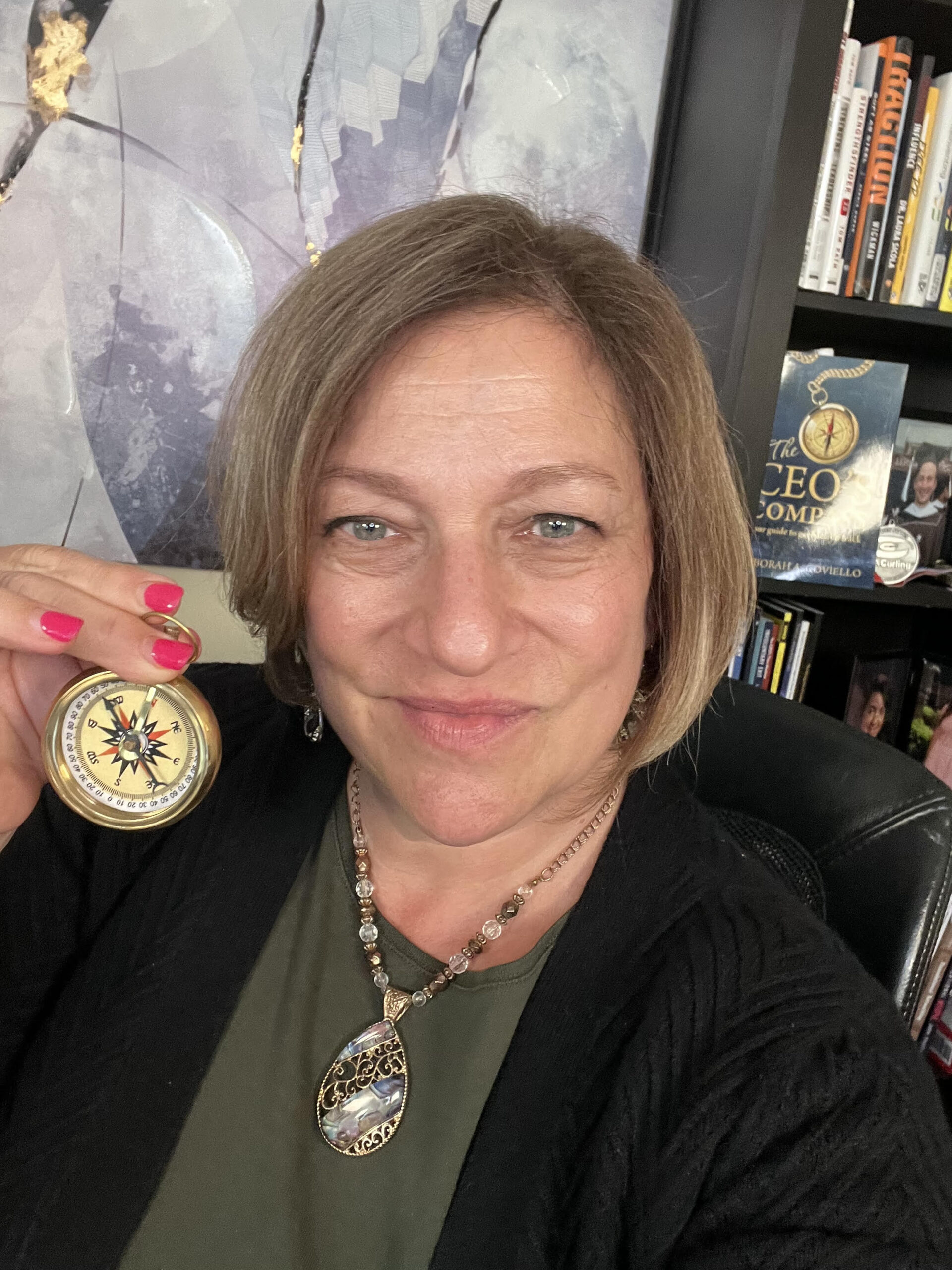
Every 6-12 months I feel off track for which the book, The CEO’s Compass: Your Guide to Get Back on Track becomes my own self help book. Chapter 1 is titled: It’s Personal – What changed and why are you off track” followed by a quote on the facing page:
 
 “Having Clarity amidst chaos cuts through the noise.” -Deb Coviello.

I was feeling off track, took some time to reflect if I was still committed to my work. I then took some time to declutter my life as it got real messy again. I had so much I wanted to accomplish, but my efforts were diluted and not having the impact I wanted. When I looked at, I found comfort in my chapter on “People: They’re your greatest tool in your tool box” for which I realized I needed help to move my business forward again.

One of the challenges I see in CEO’s is they lack the courage to ask for help until it’s too late and then they wonder why they are in crisis. Fixing the issue becomes so much more expensive than had they moved faster with external support. I see the same challenges in businesses going through Mergers & Acquisitions. They focus on the transaction and lose sight of evolving the leadership team. Businesses spend a lot of money on consulting companies to complete the project, but have they actually created chaos? The leadership teams are not equipped with the tools to sustain the new business model. I often wonder how many companies out there could use Drop In CEO services to bridge the gap between the past and the future state. Any M&A leaders out there, just know I’d love to speak to you to  help navigate the process more smoothly. Just reply to this email as I’d love to pick your brain to help with this challenge. 

So getting back to my story about getting back my story… you will be seeing a lot of changes that evolve Illumination Partners, LLC (my business entity) and The Drop in CEO (my brand) to bring our team closer to my community: C-Suite Leaders of Today, C-Suite Leaders of Tomorrow and Sponsors & Advocates for our work. I’ve called in the calvary to support me through content writing, marketing, video & audio production and even a refresh on our brand images. I’ve set an intention on investing what works and having the courage to ask for A LOT of help! 

I’m grateful I wrote the book, The CEO’s Compass to help C-Suite Leaders of today. It servesso as a gentle reminder for myself to stay on track and make course corrections as needed to enable me to be in service to my community.

Look for a refreshed look to my Get to the point Newsletter in the coming weeks that we hope will increase the value to you and make it a go to resource for you, your teams and the network. 

If you would like to learn more about the book, you can also visit my website  to preview and order your copy. Let me know how I can help you. I’d love to support you. Until then, I wish you much success-Deb
New Date / Times for The Drop In CEO CollectiveI’m so excited about the conversations and value we’re providing attendees of the Collective.

Each week, I teach people different approaches to networking that will make you memorable vs. an elevator pitch.

We bring forward educational content from our podcast or even from the community to teach you skills needed for the C-Suite. 

The spot coaching is also amazing as it’s not just from myself, but the Collective can help you also navigate your challenges. 

I appreciate the feedback about the dates / times and with that we will offer our next Collective on Monday March 20th at 12:00-1:00 and 4:00-5:00 ET to see if this will make it easier for you to invest in your career. 

If you cannot make this session, but know of someone who would benefit, please pass this along so they can register. 

This is complimentary because I care about supporting you and The Drop In CEO Community. 
Click here to get your initiation
Read More

I’ve shared with many of you I’m working with a Functional Wellness Coach to ensure my health is in check so I can continue to be in service to you. During this journey, we’ve discovered Stress has potentially cause my chemistry to be out of balance. As part of decreasing stress, I’ve been doing more things that give me pleasure and are relaxing; one of which is continuing to go to the theater. Last evening we saw the play “Annie” and while it was a feel good story, there are important messages CEO’s can learn to get better results.

First and foremost, the song “The Sun Will Come Up Tomorrow”, gives hope that you always have another day to make things right or to enjoy success and life. So many CEO’s dwell in what is going wrong vs. playing to what is going well and applying more energy. Where things are going wrong, they spend too much time in the weeds, vs. enabling teams to solve their own issues and inspire optimism. Fast Companies article about how CEO’s can lead with optimism in uncertain times is critical to enable high performing teams to meet those challenges. 

While I could gush about the entire musical score for Annie, let me share my personal thoughts. I was once a victim to circumstances and I simply wanted to “survive” until tomorrow. The turning point came when I realized I had no more energy to survive and wonder how I got to this place. I focused on the immediate vs. the future. I had my hands in most everything vs. improving my decision logic and prioritization. I worked harder vs. smarter and knew no other way. Where was my boss? Where was the coaching I needed to develop the essential skills vs. applying resources at the issues?

I am so grateful I can now see clearly these challenges are common to most C-Suite leaders and those seeking to get into the C-Suite. No where do I find a systemic approach within corporations to identify these gaps in skills nor a program to evolve them. Only a lucky few have a mentor or a coach with others falling into despair or feeling stuck. Given this insight, I have curated these gaps into The CEO’s Compass as a guide to stop and recognize the gaps and start helping leaders develop new skills & approaches to their leadership style. This is a DIY guide to get back on track, but I can also support you and your business challenges often moving you from crisis to stability in 90 days or less. Let’s have a conversation. 

If this is you, PLEASE do not continue as you have. PLEASE do start to do something different. If you are trying to get into the C-Suite, consider my book as a resource to get you on track in days vs. months. I also propose the Drop In CEO Collective that could jump start you to the right track in 50 minutes or less. Time is valuable and leveraging tools to give you back time and reduce stress is an investment in yourself that you should consider. We all want to see The Sun Will Come Up Tomorrow!

Message me if you’re interested in the Drop In Collective or click here for your exclusive invite.  

Let me know; I’d love to support you. 

Until then, I wish you much success-Deb

Read More

On the way to work I got a flat tire. Nothing special, it’s happened to all of us! The unfortunate thing was the people who installed it completed a transaction and got paid for putting on a new tire. However, they never drove it around to assure the seal was intact and the vehicle was safe. As a consumer, I want the assurance that I don’t have to worry about the flat tire happening. While driving at high speed, all of a sudden my tire pressure alert came on and showed it dropped from 35 to 20 and ultimately to 6. I was rescued by AAA and got my tire repaired by my tire dealer who said it is possible there was dirt that enabled a leak and a loss of pressure. They added bead seal and assured me after pumping it back up, it was safe.

The problem with this situation is the service provider was seeking a result – install a tire and get paid. For the consumer, I wanted Peace of Mind; knowing my vehicle was safe and the service provider had assured the workmanship was sound and validation the car would work in the end application. A big fail from a consumer perspective.

Yet the same pattern exists for C-Suite leaders; getting the results and claiming success. I propose to you that C-Suite leaders who seek results are in reality in pursuit of Peace of Mind; knowing they can sleep at night and won’t get that late night call.

Peace of Mind is a state of being for which you know you, your team and the consumer is cared for. It’s not a number, but when you do the right things and see the consumer happy, you know you have Peace of Mind.

I felt very dissatisfied after the transaction with the tire repair place and I have my fingers crossed each time I get into my car. However, this story is meant to inspire those leaders who seek results and then realize there was a better way of helping their teams to perform at the highest level based on purpose and elevating individual performance.

I would love to give a copy of my book The CEOs Compass: Your Guide to Get Back on Track to the tire repair place so they can assure their customers Peace of Mind. If you don’t want to be “That Person” who is only seeking results and truly understands that pursuing Pease of Mind is a better use of their time, consider a copy of the book to help you get there with The CEO’s Compass. 

If you would like to discuss more your situation and how Peace of Mind will get you to a different place because you’re stuck and don’t know how to get back on track, please reach out to me. I can be your compass and guide.

-Deb Coviello

Read More

Executive Presence is often not discussed as part of performance reviews or even 360 feedback, but is an unspoken necessity to be perceived as ready for the C-Suite. Even this article I link to “Are you a Leader Struggling with Executive Presence”  only speaks to the physical attributes of how you show up to give presentations which alone won’t cut it. Contrary to executive coaches or image specialists who work mostly on the external presence, only a few will discuss the internal presence which I find is more critical. Want to learn more? Read on…

Write down your answers to these questions which qualify how you will project yourself into our community

  • Why do I lead and what type of leader am I?
  • What am I most passionate about
  • What am I willing to put money down on that if we followed would make a difference
  • How do I see the world differently
  • What do I believe in that I would pursue, even if I wasn’t paid for this work. 

I never had coaching while I was in corporate (so many of us don’t get that opportunity) and it was only after I sought coaches as a business owner that I arrived at presence. How do I know I “arrived”. Every time I show up at a networking event, introduce myself on a new team or speak on a podcast, I have the same talking points and people know what I stand for:

  • I guide C-Suite Leaders of Today and Tomorrow to navigate challenges with confidence
  • I do this because I want them to struggle less and do more of the things they want to for themselves or with family, friends and community
  • I assess organizations through the CEO’s Compass with focus on Peace of Mind vs. Results to get back on track

When I show up now, people will actually comment I have great presence. They love how I introduce myself and they know what I’m about. This can be you as well.

Write down your responses to the questions you pose and ask yourself if you have clarity? Could you talk about these insights every time you show up? Does it give you confidence when you speak? 

Post your responses in a prominent place to remind yourself. Practice applying them. What response did you get from the audience you were trying to influence?

If this exercise intrigues you, but you’re still not sure how to apply, send me your responses and I can leave you a voice message on my thoughts. You can also DM me on Linkedin. Are you ready to take action? I’m here to support you.

Conclusion: You don’t need a new haircut, wardrobe or communication training until you understand who you are and why you exist to make a difference. The rest is complementary to the entire package of executive presence. 

If you find this article helpful, I would be forever grateful if you shared with a friend. I can also subscribe them to the newsletter if you give me permission. Just message me back. 

Wishing you happiness, health and great memories as we enter the holiday season.

-Deb

Read More

While most of you know me as Deb Coviello, The Drop In CEO, behind the curtain is a person that simply wants to spend more time with my family, friends and community. I love having the time to plan and prepare meal experiences that bring people together and create memories. Christmas time is a time I celebrate knowing I can do all of those things and I can say “Fa La La”. I’ve added a link to my cookie photo in this article to take you to my personal Facebook Page so you can follow me, my family, my dog Reagan and curling. I think it’s important that we take the time to get to know each other more personally so when we do come together, the work is so much more meaningful and fun. Connect with me and let me connect with you as well on your favorite personal social site. But what about “Fa La La”? Read on to learn more…

A few years ago, I was panicking to get all the Christmas shopping, cookie making, decorating and couldn’t find enough hours in the day. Don’t even ask about the Christmas cards; they’ve now become New Years cards if I’m lucky! Anyway, this particular year, things were falling apart, breaking, forgotten presents etc. and I was getting down on my self. Then out of nowhere when I didn’t know what else to say, I said “Fa La La” and threw my arms up. It was an expression of “Oh well”, that didn’t work and as a way to shrug it off and laugh at the situation. So every time things don’t go as planned, I simply say “Fa La La”

This expression became a “thing” for which my mother bought me a shirt that says “Fa La La” and showed me she cared enough about my mishaps, but also supported me as I celebrated life’s imperfections and the ability to move on. I say “Fa La La” now to you and ask for forgiveness for every time I misspoke on my podcast, mixed up my words, said it was 2020 when it was 2022, for forgetting to call you back, missing a meeting or being late paying a bill. It was because I was probably focused on the most important thing in the moment for which getting it right was less important than being in the moment. 

So my gift to you this week is to think about when / where you’ve been having challenges that ever so slightly bring you down and ask yourself how relevant is it in the grand scheme of enjoying life? Sometimes we give those little things too much relevance for which not only did something happen or not happen. It’s time to shake it off, say “Fa La La” and you would be surprised how quickly you forget about it and move on to enjoy the things you love to do.

I’m heading out shortly to finish Christmas shopping, buy some food because my mom is visiting for a month and my daughter comes home from Italy tomorrow. But I’m also buying ingredients to make Christmas cookies and enjoy memories with the people in my life. If I forget an ingredient… Fa La La. If there is traffic that slows me down… Fa La La…if don’t get to the vacuuming before people arrive… Fa La La.

So here is your challenge: Start saying Fa La La and turn mishaps into fond memories!

Wishing you happiness, health and great memories as we enter the holiday season.

-Deb

No alt text provided for this image
Read More

“Deb, do you have a minute?”, “Deb, can I ask you a question?”, “Deb, I’d like to bounce something off of you” are some of the things people are saying to me recently.  When the universe speaks to me, it’s clearly a sign that more of you are having the same challenges. There are important #RealityShifts that I want to share with you based on these recent conversations for which may change the trajectory of your 2023 career goals. Ready to read on?

Before I share the reality shifts you need to make, I want to give you some context of why these stories are the trends I’m seeing in talent as they struggle to break out and be the leaders they were meant to be. While the media & guru’s push the narratives of the “Great Resignation”, “Silent Quitting” or “Work from Anywhere”, are these really the topics we should be speaking about? I believe the root cause of all these Trends is a growing phenomenon called the “Human Awakening”.

We are realizing the energy we’ve invested in a corporate conformist society has taken a toll on who we want to be in pursuit of purposeful work. While we’ve enjoyed the experiences and resources of a traditional corporate pursuit, we are getting very, very, very restless about the work we were meant to do and how do we rediscover the person we once were. At the core of all these recent encounters is a yearning to do something different, but they are stuck for which I want to share some insights.

Start describing yourself as how you change lives & businesses

A new acquaintance of mine wants to elevate their side gig to full time pursuit as they think of retiring. They love both careers, but one is pulling them towards more purposeful work. During our casual brainstorming sessions, they describe what they do in terms of functional title: Coach, Advisor, Consultant. The problem with this, is you put yourself in a box with the thousands of others that label themselves as a title or function.

To stand out from the crowd, I recommend you describe yourself in how you change lives and business. Rather than saying I’m an Executive Leadership Coach, start saying “I help talented leaders rediscover their passion for play and make work fun again”. Wow! That’s certainly different and differentiates you from everyone else.  Think of it as a living Eulogy of what people would say about you when you’re not there.  

Start speaking as if you were in the next role you aspire to

I would be rich if I could monetize every person who shared their story with me about “I’m not this”, I’ve never been in that role, I can’t be that because I don’t have this” …Ugh, please stop saying what you’re not, but start speaking as if you are! Then if there are gaps, you address how you’ll fill in those gaps.

A colleague of mine is in career transition, and they are reflecting on what they’ve done and seeking new opportunities in what they have done in the past. They don’t see themselves as the next level higher such as the president or CEO of a company. They kept focusing on what they are not and not listening to who they are already qualified to be. I jolted them by saying, you’re already acting at the next level, but you don’t realize it. They stopped dead in their tracks and said they never thought of themselves in that way.

When we think about the skills we bring to the table, the title is simply a validation that we have everything we need to be successful. Where there are gaps, we are resourceful in bring in subject matter experts to advise us.

Could you shift your mindset and start thinking about yourself in the next role and the qualities (not qualifications) that are needed? Do you have most of the skills already and can picture yourself in the role? I can tell you that magic starts to happen as your mind shifts to a new persona. You have been the only you have been holding yourself back. Could we stop doing that and start being the person in your next role?

Start bringing who you are outside of work into your work

An old colleague of mine reached out to me who is thinking of a career transition. They know I’ve been through the same process and wanted to have a chat with me and pick my brain. They shared in advance some assets that floored me when it came to describing their history. Far different than a resume or website was the richness of color and their life passions which they brought forward in the copy. They were marketing a human being, rich with stories and pursuits vs. a resume of qualifications. They were interesting and fun and a person I would want to have a drink with and want to learn more about.

So why is it we go to work and check the human at the door? Yes, we’ll talk about our weekends with the kids and their soccer matches over coffee, but after these cordialities, its’ back to the grind. There’s a deeper message in bringing the human into the workplace far more than before. It’s about being authentic in your gifts and imperfections. It’s about discovering what makes you unique & interesting to others. It’s about being the human that comes naturally vs. conforming to a formal structure. I’m not saying you should be crazy, silly & reckless in the workplace, but stop being someone who you’re not!

I have recently started talking about Curling, Podcastingwriting a bookblogging, cooking, having 3 kids in Europe and everything that I’m passionate with anyone and everyone who I meet. I’m far more interesting to others than being “The Drop In CEO”, a coach or business advisor. I’m letting myself be myself, which to some it’s called a “Personal Brand”, but we are unique in that way. When we conform to ways of working like everyone else, we lose ourselves. When we position ourselves as the collective of all our passions & pursuits, we become much more interesting, and doors open. We are no longer that resume that goes in the “No” pile but move into the “Interesting” pile.

The shift is to start being the person who you already are into work, so we no longer have energy shifts into who others expect us to be. People might not like who you are or won’t find you interesting. But then you can determine if this is your tribe or should you be someplace else. It’s a risk worth taking to change the trajectory of your career.

Now let’s talk about you. Do you have questions about the trajectory of your career and don’t know who to talk to? Consider The Drop In CEO Collective where I bring together passionate leaders who want to make a difference, but need support. In the Collective we learn new skills, strategically network with others seeking the same goals and you get spot coaching that is complimentary. Now ask yourself, are you work investing 60 minutes a month into your career? Are you stuck and need someone or a group to bounce ideas around. I’m extending this offer to you and if you’re interested, message me so I can share an invite only link to attend#askDeb

Are you ready for making a reality shift in your career or will you continue to follow the societal imposed trends? Take control now and let me part of your path forward and creating your 2023 career goals.

Until we meet, be well!

-Deb

Read More