Our Archive

Blog Archives

Dropinceo > Blog >

I wish I had someone give me advice about the importance of networking within your team and close circle. Some people just seem to have a knack for this; you see them joking and swapping stories about cookouts they attended or chatting about a recent sporting event. You watch this and wish you could do that, but shy away because it feels awkward. Not only am I talking about myself and you if you’ve ever experienced this, but I’m also speaking to the leaders who see this competency gap in their people.

What are you doing to provide feedback in a way that is positive and shows the value of networking? It is the difference between a team that simply gets results vs. a high performing team that fulfills a purpose and leaves an impact. 

Fast Company speaks to the benefits of internal networking:

“When you continually network with other employees within your company, you’re building relationships, establishing rapport, and cultivating a mutual trust and respect that will enable higher productivity and a better overall work experience.”

I learned later that it takes a concerted effort to 1) choose to network, 2) decide how and who to network with, 3) actually doing it, 4) and being clear about the outcome you want to achieve. 

I remember going to a networking event feeling quite awkward, but went in with the mindset that I would work the room and by the end give out 3 business cards. With that intention, I gave out 2 business cards and was later asked to join the board because I had the right presence and the way I spoke, they felt I would be a great leader. This worked well for me, but was guess work. I had no formula for successfully building a network.

We need to set an example for ourselves and the team to practice building this competency so it becomes natural. I wrote an article “How to be a Memorable Networker” . In it, I provide a step by step process on how to start a conversation with emphasis on asking well placed questions, listening and showing the other person you heard them. It is the foundation of building relationships.

I remember spending time with our sales team and hearing the complaints from customers and how we were not meeting their expectations. While solving the customer’s issue was important, the greater opportunity was building a trusting relationship with the sales person; letting them know we heard them. With that approach, future conversations went from a colleague who may rant about poor performance to one of collaboration and how do we make the customer right. This is the value of internal networking. 

Zig Zigler once said, “You can have everything in life you want if you will just help enough other people get what they want.” 

When we spend time building this competency that enables better relationships, the individual and the team can achieve higher levels of performance. People need to focus on building competencies as leading indicators of success. When people hone these competencies, the performance and results will come. 

While I’ve shared the importance of it, we now need to encourage it in ourselves and the people in our circle. Ask a colleague to go for a walk with you, join you for coffee, invite them over for a barbecue, go to lunch, set up a 1-2-1 and just set aside time to get to know each other and not always about work. These actions are simple to do, but it starts with your mindset, your intention and the willingness to try it. With all new competencies it takes practice until it becomes a skill. Are you ready to invest in this new skill? 

If this insight was helpful, share this article with others. If you have a unique challenge and wish to have a complementary conversation, please reach out to me. I love helping C-Suite leaders of today and tomorrow reach their career goals. 

Your time is valuable, so I wanted to share a few quick links so I can be of service:

No alt text provided for this image
Read More

Great wisdom comes when you reach out to your network and ask two simple questions:

  • What were the opportunities you had that supported your career growth? 
  • What were the challenges and how did you manage them?

I started on a journey to curate the best insights from industry leaders and bring them forward to you so you don’t have to struggle. Both leaders of today and tomorrow have the same challenges; just at different levels of evolution. To my surprise, connecting professionals has had a significant impact for me on many fronts. 1) It gives me the opportunity to stay current on the issues facing leaders of today and tomorrow. 2) It also allows me to build relationships with people I sincerely care about.  I am pleased to share the insights I’ve gained from a corporate leader who I recently spoke to. 

Why do you lead and what is the value you provide to people in your care?

Leadership, if one chooses, is a pursuit that continually evolves with a positive attitude and a thirst for knowledge. Whether through being a lifelong learner, having a mentor or investing a mastermind, we always need to develop these skills to have the best impact on the people we serve and lead on our journey. The first step is to check yourself and ask if you want to lead and what type of leader you want to be.

I find this step is the first in determining Who you are, Who you serve, How you will serve and what problems you can solve. This simple exercise getting crystal clear on your “elevator pitch” is the key to practicing and then coming forth as this leader. After all, being a leader is about marketing a vision and inspiring others to follow and elevate their capability to achieve. Learning marketing as part of your toolkit is a key step in messaging who you are. If you can say it and see it, then you become it!

Evolve your value in an environment that cultivates your passion and skills.

Find a job you are passionate about, consider a rapidly growing / changing company and one with opportunities to interface with customers. When you love the work you’re doing and throw in a fast paced environment, learning is at its highest level both the good and bad. You learn from this process and iterate rapidly to hone your technical and leadership skills. I found when I work in startup companies, you wear a lot of hats, you have broad responsibilities and you see the impact of your work much faster. 

“Pursue excellence in everything you do and give up on perfection.”

Once you’ve honed your value and expertise, you must be able to apply your skills with speed and agility. People need to see your value and also be brought along in the process. We must have grace when it’s not perfect and acknowledge our humanity. With leadership comes the responsibility to have an impact, but also be mindful of any risk of not doing things right. Leadership is about gaining respect of the people in your care and when they understand this style of leadership, they will follow and have your back. 

Be a student of people – this is how you connect and have greater impact. 

When you take your technical knowledge and add the art of reading & engaging with people, you perfect your impact. You need to read their body language, their engagement and how they look at people. I might also add you should focus on what is said, but more importantly what is not said. Sometimes the silence speaks volumes and a wise leader will study this deeply. 

Invest in learning vs training.

Leaders need to assure that the training of their people achieves a greater outcome by coaching the skills needed until competency is achieved. Through an iterative process of asking questions about their training and how they apply it to what they do and how they think, we transcend the spectrum to a learning environment. Companies that simply check the box of training as a matter of compliance miss an opportunity to communicate a message that they care. By showing people you care about them as humans vs. a transaction we build trust in your leadership and might I say, your brand. 

Always ask for feedback.

Great companies engage with people as part of consumer insights and market research to ensure the products and services provided meet their needs. Leaders that recognize that while we are in service to the needs of external customers, investing in the feedback of your internal customers provides you insight into what people are thinking. Create a culture of always asking for feedback. If you know me, I teach a workshop in providing a positive framework for soliciting feedback: What should I continue, what should I start doing and what should I change. All constructive and actionable for which leaders leverage these insights and make interactive improvements. People respect this action and continue to solidify your position as a leader worth following. 

Learn what you will do and not do.

Great wisdom can be gained by modeling the behavior of leaders you admire and have succeeded. Even more powerful is knowing what you will not do as a result of a leader you have worked for. Taking the time to qualify your values and ways of working also add to your marketability as a leader. Yes, I am inserting the concept of marketability, because after all, people are loyal to great brands or great leaders. Being consistent in the leader you want to be and leading with your values will resonate with the people who are attracted to you and will support you. 

Embrace the 70 / 30 Rule: be the leaders you want to be and it will happen.

We are required to deliver results and our employees, the business and our customers depend on us to execute consistently. However, you must continue to invest in yourself and evolve your impact by seeing and acting at the next level. This is the key to being seen and recognized for the next level. This wise leader shared that the formula is to be 70% in your current role and 30% performing at the next level. Take some time to look over the work content you do on a daily basis. Pick areas where you can improve your skill. One example I had was in the way I did presentations. Most leaders at my level did powerpoints in bullet form and spoke to their talking points. At the next level of leadership presentations, visuals and pictures were used to communicate messages and only supplemented by a few talking points. The presentation moves from a place of disseminating information to one that communicates powerful messages for influence. 

What does all this mean?

In a Center for Creative Leadership Article, self promotion can be an asset to both yourself and your team. Leadership comes down to your value and marketing of who you are and how  you will lead. When we establish our core values, be clear and consistent on our ways of working along with continually learning and evolving to the future needs of the market (your people, the business and customers), we evolve into the leader we want to be. We don’t often think about marketing ourselves as it can be seen as “showy”. However, we need to own how we show up in the market and become a person worthy of loyalty and followers; that’s marketing plain and simple. 

Many thanks to the leader who inspired this article. I’m forever grateful to know this person and to share their insights with you. 

If this insight was helpful, share this article with others. If you have a unique challenge and wish to have a complementary conversation, please reach out to me. I love helping C-Suite leaders of today and tomorrow reach their career goals. 

Your time is valuable, so I wanted to share a few quick links so I can be of service:

No alt text provided for this image
Read More

According to Pricewaterhouse Cooper (PwC) 2021 Global Crisis Survey, 62% of businesses used their crisis plan in response to the pandemic and 95% of the businesses reported their crisis management plans needed to be improved. Is Crisis Management a compliance activity neatly tucked in the corner until you need it or an integrated conversation into our daily / weekly / monthly operational conversations? Based on that 95% statistic, I think it’s time to wake up leadership to the harsh reality that their job is not done until they apply the 7 Principles of The CEO’s Compass. 

When I’ve dropped into Crisis events over the last 20 years, I have found a common theme amongst leaders. They have a false sense of calm because they can check the box on their compliance activities. They’re getting results (most of the time) and their team is loyal (or perhaps complacent). This calm before the storm is common and those that don’t respond quickly to a changing landscape (loss of a leader, changing customer requirements, changing customer perception), they find themselves moving down the Crisis Scale from being in Control, down to Chaos and finally Crisis. When I’m finally called into bring things back into Control and move them up the scale to Continuous Improvement and further into a Competitive Advantage, The CEO’s Compass provides you the direction of where you’re off track and how to make course corrections: 

Framework of The CEO’s Compass to Navigate to Peace of Mind

  • Purpose – test the landscape and ask if people understand the purpose of the company in the context of their job function. This is an indicator that cascaded communications are effective
  • Performance – no longer the lagging indicator of results (quality, service, safety, sales), but leading indicators of closing the capacity, capability & confidence gaps of your team to meet the purpose of the company. 
  • Past – if you or your direct leadership team cannot articulate the deep culture that each individual brings to the table, go find out now. In doing so, you pay respect to the individual and their unique qualities that made them special and the right to be part of the organization
  • Pride – building on understanding one’s past and their culture, you need to go the extra mile and understand their unique gifts and intellectual property they have. Whether you use them or not, by asking the question, you pay respect to the individual, they tend to be more loyal and you never know when you may need to leverage those gifts. Leaders that skip Past & Pride simply have a transactional workforce and they leave their minds & hearts at the door to your business.
  • People – developing the mindset & skills of your people fall on you to remove any barriers to enable them to reach their full potential. Ensure you have a robust program that starts with strategic investment in your people through 1-2-1’s and capability development. 
  • Process – the dynamic between individuals and functional groups is as important as people development. Without coaching team dynamics and leveraging each other’s skills, you will fall victim to wasted time and lost revenue due to process inefficiencies. 
  • Platform – a leader who has an evolving team and moving towards high performance needs to provide them with tools to assure they can maintain high performance. Often tools that enable good decision logic, prioritization and accountability are critical when your people are taking on more work and need to increase their efficiency & effectiveness else they’ll burnout. 77% of people surveyed in a Deloitte survey say they’ve experienced burnout. 

I can assure you that most leaders are off track on 2-3 of these guiding principles to prevent a crisis. There is nothing in here about a crisis, communication or risk mitigation plan as typically developed by your Crisis Management Officer. If you’ve not shored up the compass, you become the 95% statistic of the company not being prepared and needing to make improvements. For the team that is navigating towards Peace of Mind, the 8th compass point, the Crisis is the opportunity for which their fullest potential will be realized. 

If this insight was helpful, share this article with others. If you have a unique challenge and wish to have a complementary conversation, please reach out to me. I love helping C-Suite leaders of today and tomorrow reach their career goals. 

No alt text provided for this image

Your time is valuable, so I wanted to share a few quick links so I can be of service. Click the link if you’ve been thinking:

Read More

The worst thing that can happen to a leader is to have a complacent workforce. You may be getting your results and the team is perceived as loyal and dependable. However, underneath the tip of the iceberg is a crisis brewing. The crisis becomes the inability for you as a leader to navigate, should anyone leave the organization or possibly become obsolete because your team simply doesn’t care to grow. You’re lulled into a sense of calm when in actuality you’re doing a disservice to the people in your care and the organization you lead. For my audience that may not be a leader of others, the content in this article can be valuable tips for you to take action before you become obsolete. 

Planning for a crisis instills a sense of urgency and a risk mitigating mindset. When it comes to a complacent workforce, it is a crisis in the making. It is a matter of time before the planets line up and you have challenges in achieving your results.

Let me refresh you on the Crisis Scale so you understand my reference: 

  • 5 – Crisis: You’re losing customers, resources, competitive advantage
  • 4- Chaos: You’re not losing customers yet, but you’re in fire fighting mode and trying to survive another day. 
  • 3- Control: You have everything in order and achieve your results.
  • 2- Continuous Improvement: You continually seek new ways of performing
  • 1- Competitive Advantage: Your customers are asking you to share your best practices. 

Framework to ensure your team is loyal vs. complacent:

  • Challenge them with Breadth or Depth – For the subject matter expert, give them a project in a new area for which they have less expertise. For the generalist who knows a lot in many areas, give them a project where they need to increase their knowledge & impact in a specific area. 
  • Push them out of the nest – Make it part of their development plan that they need to move to a new role every 1-2 years. It forces them to prepare for the change and capture their tribal knowledge to share with the next person. It also builds new skills in anticipating change. 
  • Create a sense of urgency – Start the dialog to let them know they’ll need to grow in breadth and depth and ask them to come with suggestions on where and how they’ll do that. It creates more value for the organization and it makes them more valuable. Without creative input brought to the conversation can be a condition of employment and a good review. 
  • Where a career ladder is not established suggest alternatives – If someone is at the top of their career position (i.e Director of procurement), suggest areas where they can work in different areas of the business that are downstream. This may include working in Operations or Quality where the output of their current role in procurement has an impact on those other functions for which they can add value as well as learn. 
  • Help them discover opportunities before they experience a crisis – This is especially important to the less senior employee who has a thirst for knowledge. Often they leave the company because they become bored. However, if you create an “apprenticeship” model for which they rotate every 6 months, you keep them interested and engaged. 

The impact of this framework is creating a workforce that is loyal to you or the company because you simply cared. You cared about them as a person to seek additional value from them and invested in their learning. They become loyal to you and will bring their “A” game to the challenges and even more important, you will leave a legacy in the minds of people in your care. After all, the loyal connections we make are far more important than simply the results of a complacent workforce.

If this insight was helpful, share this article with others. If you have a unique challenge and wish to have a complementary conversation, please reach out to me. I love helping C-Suite leaders of today and tomorrow reach their career goals. 

No alt text provided for this image

Your time is valuable, so I wanted to share a few quick links so I can be of service and then get you to this week’s insights:

Read More

A special message from Deb to you-Listen Now

We were having challenges getting the organization to the root cause of an issue. Something was missing and we were seeking the missing link. One day my employee said “Deb, do you have a minute?” and showed me a whiteboard. They started sharing disjointed ideas, and I vaguely understood the point they were trying to make. They were very talented, but when it came to articulating their big idea, it took some time. However, we eventually translated their Big Idea into one of the most impactful programs in Root Cause Analysis and I continue to use it today.

As a senior leader with people in your care, you see them struggle because they cannot articulate their passion and ideas into something that can create buy-in and lead to execution. Have you or the organization ever developed the skills to guide them from disjointed thoughts into a well-crafted message? I don’t want you to struggle as you ponder this challenge and provide you a framework to speed up the process of developing your leaders of tomorrow.  

Framework for channeling energy into a well-crafted message:

  • Be excited and ask more questions. Ask them to continue to articulate and write down their ideas
  • Ask them what is the problem that this idea solves… or ask what is the outcome they’d like to achieve?
  • Ask them to write down their ideas and ask them to organize their thoughts; sequence or prioritize them.
  • Ask them what is the current state and the gap they want to close?  
  • If the ideas are still random, ask them to group them into common themes. Ask them to create a sentence that summarizes the concepts.
  • Finally, ask them to organize them into a presentation / visual that lays out these thoughts in sequence and ask them to return and communicate their message again using this approach 
  • Another resource you may find helpful is to help Aspiring Leaders Socialize their content to validate & enrich their ideas. 

This may sound simple, but when you have only so much capacity in a day to run the organization and evolve people, these tips are meant to give you the tools to develop the leaders of tomorrow. 

A short video message from Deb to support Capability in your organization

Building new skills takes practice and I want to be there for you. We cover this framework in our Drop In C-Suite Academy which is still accepting students for enrollment. If you would prefer a 1-2-1 approach, I can also offer my coaching services. I can also create a custom approach to come into your organization and provide & mentor the skills as your partner. 

One more resource for you – my Drop In CEO Podcast episode on “Powerful Words for Influence” you may find helpful in messaging big ideas. 

For more information about The Drop In C-Suite Academy (CS)  dedicated to the aspiring C-Suite leader, simply register to get on the waitlistemail me or connect with me for a quick chat. I can’t wait to help you be successful and reach your goals!

For more resources, you can listen to The Drop In CEO Podcast or check out my book The CEO’s Compass will help you get on track in days not months. 

No alt text provided for this image

Resources

Good Reads

Essentials of a Successful Marriage by Abiola Soremekun 

What would you say if I suggested that what we learn from marriages is directly applicable developing the leaders of tomorrow? I’m pleased to know Abiola Soremekun who writes a simple but powerful book on marriage, but what can we learn from it for other pursuits? She discusses Listening, communicating and trust among other topics; so relevant to all relationships; especially those in the workplace or our businesses. Why would we treat people in our care any differently than those we care deeply about? Think about it and I’d love to know your thoughts!

Good Music

Pianist Marlowe Carruth’s Eternal Light – today I am inspired by finding new ways to connect with senior leaders and those that are in your care. I’m developing offers to help you struggle less and guide leaders of today and tomorrow. When I listen to this piece, it provides me hope that my work will have a lasting impact on those who I share the best insights I can provide. 

Good Advice

“Sometimes you feel like trial and error is a rite of passage. But you don’t get any extra points at the end of your life for having more trial and error or more pain.”

 –Ben Wolf

For more inspiration, Listen & Subscribe to The Drop In CEO Podcast

If you love the podcast, please write a review. We are offering a quick tutorial to make it easy to leave a review.

Read More

You have an outstanding resume. You land multiple interviews. And yet somehow, the offers just don’t come through. You’re celebrated as the subject matter expert, but when a new job opens up at work, you’re not even considered. You’re not alone. This scenario plays out day after day amongst highly talented professionals, and causes them to question their capability and lose their confidence.

This isn’t a skills problem, this is a pitch problem. Society teaches us to present information first and ourselves second. Even if you learn the finer points of moving forward proposals or initiatives, you’re still not recognized as the person who is next in line for a promotion. The challenge becomes being so good at our jobs that people want to keep us in these critical roles. While we can fall into the abyss of being a victim of circumstances, I seek to provide you with some tips to help you take control of your career.

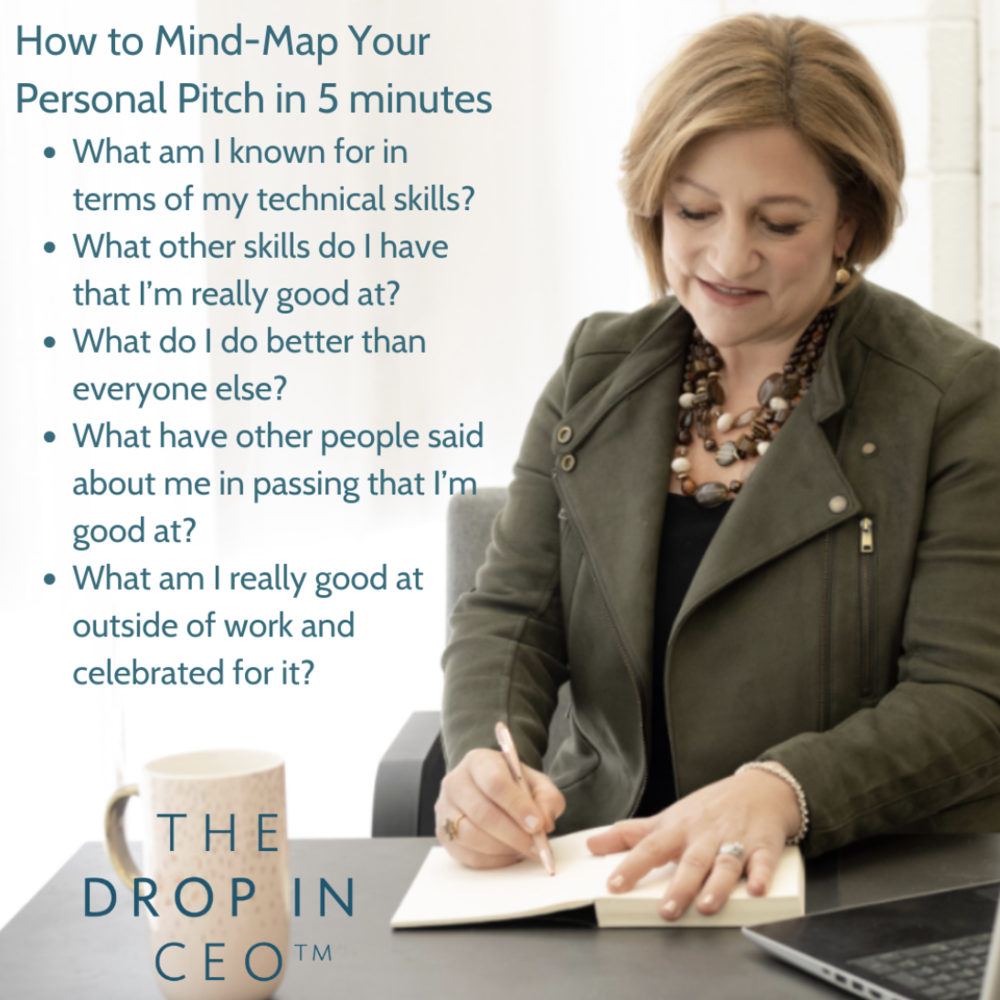
Mind Map Your Personal Pitch in 5 minutes

We need to get out of the box that people put us in. You may be a Compliance Manager, a Senior Customer Service Representative or a Senior Director of Operations and people know what those roles are. You are judged on your deliverables against a job description and often without points for creativity. What I propose is for you to go outside the boundaries of a job description and answer a few simple questions about what makes you different. This will help you to position yourself to get a better result in terms of career advancement.

Write down words & phrases that come to mind: 

  • What am I known for in terms of my technical skills?
  • What other skills do I have that I’m really good at?
  • What do I do better than everyone else?
  • What have other people said about me in passing that I’m good at?
  • What am I really good at outside of work and celebrated for it?

Next, circle things that are related to each other to see relationships that showcase your uniqueness.

For those items where there are unique qualities, are there other industries or jobs that celebrate these skills, but maybe use different words to describe them?

Here’s an example for me: 

Problem Solver, Cut Through the Chaos, Crisis Management, Speaking, Listening, Facilitating Conversation, Soothing Voice, Organizer

I happen to love music and think of an Orchestra & Symphony as ways of bringing different groups together and blending them into something that is beautiful & productive – so I think of this as building relationships amongst disjointed sounds or activity.

I could now consider myself as:

  • The Conductor of Crisis Mitigation
  • The Orchestrator of a Problem Solving Culture
  • The Drummer of Project Management

I know these might feel uncomfortable at first, but think about it; what if you come out and say: “I’m the Conductor of Crisis Mitigation. I drop into situations and can quickly assess the landscape and bring a crisis into control while maintaining customer relationships.” Enrich this pitch with your experience and you will stand out in a noisy field of other experts!

Sound easy? Give it a try! However, I find these mind mapping activities are sometimes best when bouncing ideas off of someone else. You need to give yourself the freedom of free flowing thinking as you explore these questions for yourself. Finding your personal pitch can be the difference between being simply the expert and having the stand out persona that people talk about. 

I offer a 30 minute complimentary consultation to discuss your unique situation because I simply want to help you and others struggle less. I want everyone who is aware they need to try something new to struggle less and achieve their career goals.

No alt text provided for this image

For more information about The Drop In C-Suite Academy (CS)  dedicated to the aspiring C-Suite leader, simply register to get on the waitlistemail me or connect with me for a quick chat. I can’t wait to help you be successful and reach your goals!

For more resources, you can listen to The Drop In CEO Podcast or check out my book The CEO’s Compass will help you get on track in days not months. 

No alt text provided for this image

Resources

Good Reads

This week, I’m filling my suitcase with books that have been on my shelf that I’ve been meaning to read. I’ve been so busy creating content that it’s hard to take in new content. While on vacation, I plan to fill my mind with new thoughts and hope to share them with you when I return. 

Good Music

Ludovico Einaudi – I Giorni:

I’ve been feeling a little overwhelmed, a touch sad as well as exhilarated for vacation coming up. This music embraces all of these emotions, but ultimately brings you to a place of hope that everything will be just fine. All of these emotions are what makes the human element exciting. I do hope you enjoy this piece. 

Good Advice

While my post is about standing out; please know don’t go it alone. We are better because of leveraging the community of supporters and guides to help us to reach our fullest potential. My guest on this week’s podcast had these words of wisdom to share: 

“We idolize the individual as the unit of being, right? …but if we think of ourselves as social organizations we would think more collaboratively and inclusively.” 

–Mark Monchek

Listen and subscribe now

P.S. If you love the podcast, please write a review. Not sure how? We’ve created a quick tutorial to make it easy.

Read More

One of the biggest frustrations I see in a corporate setting is when great work never gets implemented fully because of poor change management. New and innovative ideas are often overlooked because we rarely give our subject matter experts the framework to socializing their proposal to get buy-in. This is the pain point we need to address to evolve the capability of our experts. 

I call this the SME Conundrum; the Subject Matter Expert who is celebrated for their expertise, but then falls short because we’ve never developed them beyond their area of expertise. They have gotten ahead because of their expertise, but no one has taught them how to socialize to get buy-in and move it forward. This is often necessary in a cross-functional environment and tiers of stakeholders who need to be consulted. When we don’t develop these skills in our SMEs, they lose their confidence and become a quiet contributor vs. your next stand out C-Suite Leader. 

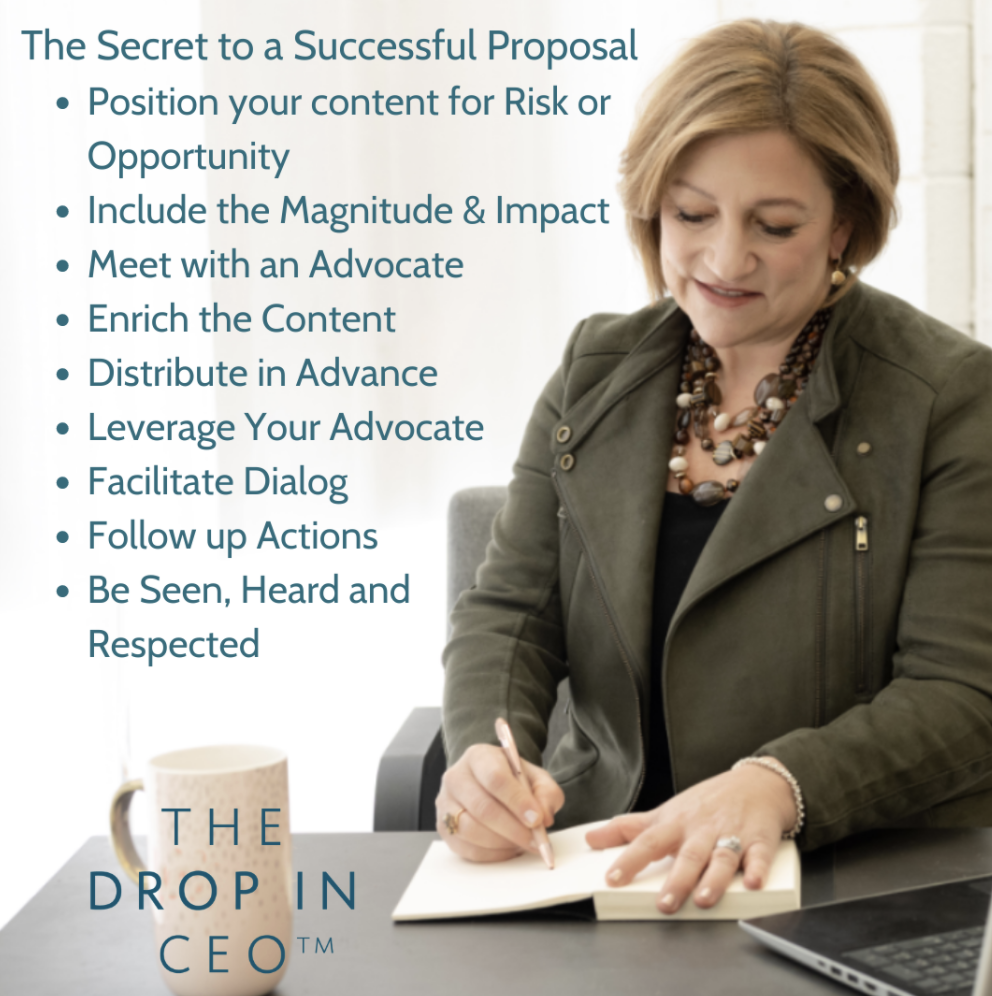
The Framework to Socialize a Proposal for Buy-In

In a large corporation, I was required to cascade a new initiative through our plant managers and I knew it would be an uphill battle. With so many initiatives happening at once, how was I going to layer on another? Instead of facing glazed eyes and courteous deflection I positioned it in a way that used their language, their pain points and how they could benefit from the work. Once they understood the potential value along with my commitment to partner with them, they soon provided feedback on how it could work. With an evolved framework that made sense to them, I shared it with our senior leadership committee and was able to get it through. The success came because I had socialized in advance with either an advocate (or critic) to evolve how it could work.

Often, when new ideas are presented, leaders may deflect or simply defer because no one wants to go first in approving it. With an advocate in the room who can speak to the benefit, silence or deflection becomes constructive conversation. It then evolves from there and even if there are gaps still to be closed you are seen, heard and respected for facilitating constructive dialog.

In the end, I was able to move the initiative through all the plants. But, it took hard work, not because of the technical details of the initiative. Implementation comes easy. It is the socialization of meeting with stakeholders in advance that is the hard work; but necessary to have a smoother and faster implementation.

Sounds easy? Well, it can be with a framework for which I’m providing a simple tip sheet below: 

No alt text provided for this image

To hear the rest of the story and details around this process, listen to my upcoming podcast episode which airs Friday April 1st. Here you will hear more of my secrets to a successful proposal.

  • Do you have the skills to try this on your next proposal? 
  • Do you know someone on your team or in other areas of the business that can benefit from learning these tips to be more effective as a leader?
  • Would you like to talk to someone about these challenges and glean a few more tips? 

I offer a 30 minute complimentary consultation to discuss your unique situation because I simply want to help you and others struggle less. I want everyone who is aware they need to try something new to struggle less and achieve their career goals. 

For more information about The Drop In C-Suite Academy (CS)  dedicated to the aspiring C-Suite leader, simply register to get on the waitlistemail me or connect with me for a quick chat. I can’t wait to help you be successful and reach your goals!

For more resources, you can listen to The Drop In CEO Podcast or check out my book The CEO’s Compass will help you get on track in days not months. 

No alt text provided for this image

Resources

Good Reads

Courageous Cultures: How to Build Teams of Micro-Innovators, Problem Solvers, and Customer Advocates by Karin Hurt. Karin was my podcast guest this week and her unique perspective to change how you approach problems and move teams is amazing. Please check out her book and also our podcast interview this week to learn more. 

Good Music

Soundcritters – Heroic Opportunities – I do hope you listen to this piece if you are an aspiring C-Suite leader who has the right mindset and is seeking the path towards that goal. This is very inspirational as it pushes you forward once you have set your mind to invest in yourself and personal development. 

Good Advice

So often we wish our bosses could be different. We often wish to achieve the next level; you’re a supervisor and want to be a manager. However, you can be the person now. You can be who you would want your boss to be. The only thing holding you back is yourself. Start being the boss you want to be remembered by and soon people will gravitate towards you because you are becoming a leader. When you behave like a leader, you become that leader. The title is simply the recognition. 

 “Be the leader you want your boss to be.” 

–Karin Hurt

Listen and subscribe now

Read More

Several of my students have asked me: “How do I decide if a job or opportunity is right for me?” A few years ago, I struggled with the same issue. I’ve made decisions and later found the job was not right and it quickly came to an end. Later in my career, I was more grounded and made better decisions for which I’m grateful. The process of choosing a new job or approaching any big decision can be heavy with emotion and fear of the future.

You start with the emotional roller coaster.  You wonder if you can fulfill the role? You’re excited to share the prospect with others. And then a little thing starts showing up inside of you. You have a sinking feeling in your gut. You try to rationalize these feelings whether good or bad. They can even bring you tears of joy because it’s everything you’ve ever wanted and you feel like you arrived. But in the end you find yourself festering over the details and sometimes paralyzed to make a decision. Emotions wear off and now you’re left with needing better decision making skills. 

Values, Needs & Purpose Framework: 

When making decisions, I find it easiest to ground myself in the following:

My values – family, rest, service, home cooked meals, community

My needs – financial, health, location, retirement, close to family

My purpose  – greater calling or what feeds your soul

It’s important to use this framework and create your own metrics for decision-making – be it a new role or and everyday challenge.

But how do you weigh your choices against this framework? It would be ideal if the choice or opportunity fit all three – values, needs and purpose. When aligned, it’s a green light all the way.

What if your opportunity only checks the box on two of the three?  Could you live with it for the short term knowing it satisfies your values, needs or passion in the long term. Then, you might go for it. 

I was once faced with a job offer where my values & needs were checked, but not my purpose. I struggled with it, but then I took the high road and said, it was a means to the end in achieving my purpose. – then I can live with the decision. That role led me to my dream job 2 years later. 

But what if the role fulfills your needs such as financial, health, location, but it would require violating your values of rest, home cooked meals and it did not fulfill your greater purpose. You could take the role and be successful, but chances are it’s not sustainable.

So if you can’t check the box in all three, for the one you cannot, ask yourself how long are you willing to do without and if only a month, then pass on the opportunity. If you can pause for 2 years, then okay as long as you have a plan to do the work to fill your soul.

This work cannot be done quickly. A disciplined leader has to do a few things in order to move through this: 

Pause & reflect – what are you feeling and acknowledge the energy? It’s important because the chemistry between what you’re feeling in your gut, in your heart and your mind are on high alert and you need to acknowledge it. Your body knows when you’re on the precipice of something new. The body needs some time to equilibrate to recognize this is a place of growth and refining your guiding principles for making a decision.

Look at the framework of Values, Needs and Purpose. If you can check the box on 2/3, you’re in a good place as long as you have a plan to fulfill 1/3 down the road.

If you’re only at 1/3, then evaluate how long you can live in that state of imbalance and if less than 6 months, it may not be right and go in a different direction.

Using the Framework to Make a Leadership Decision

Think of your situation. 

Can you apply the approach of what are your values, needs and purpose and use that to help you make a decision on a new role or position?

By following this framework you respect the weight of the decisions you’re making while building new leadership skills for future decisions.

For example, the next time you need to hire a team member you can ask yourself the three important questions regarding value, needs, and purpose. Do they have the same values and needs that the business has? Do they express a greater purpose for which they can grow with the organization?

If this makes sense and this insight can be valuable to you and others, I’d love to have a conversation to help you or the communities you serve. I can share my insights through a webinar or speak in person. I can share with you The CEO’s Compass, my book that has many of these insights for C-Suites and Aspiring C-Suites. I also offer you my C-Suite Academy that is to serve the Aspiring C-Suite who wants to take control of their career and get promoted. I’m here to help you achieve your goals. 

For more information about C-Suite Academy (CSA) dedicated to the aspiring C-Suite leader, simply register to get on the waitlistemail me or connect with me for a quick chat. I can’t wait to help you be successful and reach your goals!

For more resources, you can listen to The Drop In CEO Podcast or check out my book The CEO’s Compass will help you get on track in days not months. 

No alt text provided for this image

Resources

Good Reads

This week, I did not have time to read something new. I’m in a place where I’m managing multiple accounts and instead of filling my mind with new insights I decided to give my mind some rest. Sometimes when you rest, more creativity comes through vs. filling it up with new information. Rest is good I keep telling myself and it may be what you need right now for clarity and decision making.

Good Music

NIGHT Part One: Snow – Solo Pianist George Winston – from DECEMBER

George Winston is an artist I discovered many years ago who’s pieces mirror the seasons of the earth, but also parallel seasons of change and decision making. In this piece, it feels like your heart and mind racing which is what you may face with a difficult decision. Discover this artist as it may speak to your soul. 

Good Advice

“Most of the issues that we are experiencing throughout our lives are based on that dysfunctional disconnection between emotions and feelings.” 

–Dr. Kinga Mnich

Listen and subscribe now:

Read More

I remember having a 1-2-1 with my boss and feeling proud of how well I prepared for that meeting. I knew I was going in with concrete topics I wanted to discuss and solutions to each for a good conversation and enrichment. To my surprise, they said they appreciate my ideas, but told me to only focus on the short term projects and not the long term ones that could make a significant impact. I left the meeting deflated and questioned if I was in the right role or was I doing the right job. I thought my boss was a bit harsh and I couldn’t understand it. I wanted to react, but instead I simply responded with compliance to his request and left the meeting unfulfilled.  

Have you ever felt that way after a meeting? Knowing this can be a challenge for many, I wanted to provide you some insight in how to win over difficult people. 

Check your mindset before evolving new skills to manage difficult people.

The first thing we must do is to check in on yourself and your mindset when it comes to who you “perceive” as being difficult. I suggest you think about a particular situation you’ve encountered and these themes about being perceived as difficult:

  • It’s a gap between your standard of behavior and theirs
  • If you were having a bad day, would you want others to judge you in that moment as the way you are all the time and with everyone?
  • Could there be a reason why they behave that way that is embraced culturally? It may simply be not acceptable in the culture you are familiar with

What does it mean to be perceived as difficult?

Let’s also ground ourselves in what it means to be difficult because these are the items that can trigger you to “react” vs. “respond” and control your interaction with that person.

People are perceived as difficult when: 

  • Micromanaging your work
  •  Come across short – you interpret them as being condescending
  •  Publicly humiliate you
  • Chastise you for sending an email or reaching out to a person in the organization
  • Nit picking about insignificant details in a presentation

So now that we’ve qualified the gap you see in the people and the scenarios for which they show up as difficult, what are some tools you can employ to win over difficult people?

Employ a Framework that assumes the person is good and means well

Starting from a place of assuming the person is just like you and has good intentions. Also know there could be external influences on this person that cause them to behave in a way that could be “survival” in the culture they reside. You can go in with this approach that could improve the outcome of a 1-2-1 with them:

  • Gratitude – thank them for their time, guidance, or feedback. Relate it to a recent issue
  • Acknowledge them – sometimes these individuals are seeking attention and being “loud” or imparting their views is a way that speaks to their value or higher needs. They may not be getting acknowledged by their peers or those higher in leadership. 
  • Discuss the Gap between standards or expectations – this could be behavior, culture or ways of working. Be clear to show your view vs. your bosses view and gain consensus on the gap. Ask probing questions about their view on the gap and ways to close them. Again, it could be they don’t have good skills in communicating gap, so it come across as “difficult”

Try this on a colleague before you try this on the person you perceive as difficult. Once you have the confidence, go in strong expecting the best. The good news is you may come to a higher level of understanding about the person and then you no longer see them as difficult. The even better news is if the person continues their behavior, you’ve at least developed a new skill in having a constructive conversation and you responded with control. This skill can be taken to all parts of your career and personal life. 

So what happened to me and the person I perceived as difficult? I practiced this framework and they no longer picked apart my work. I was gracious to their needs and keep them informed of the work I was doing. They continued to communicate their support for the work I was doing and kindly provided feedback in a way that was constructive vs. destructive in the past. Who knows, I may have taught the other person new ways to communicate! 

Sounds easy? Maybe it is easy, but hard to develop the new skills on your own.? My C-Suite Academy contains content like this and so much more that will help you take control of your career. 

For more information about C-Suite Academy (CSA) dedicated to the aspiring C-Suite leader, simply register to get on the waitlistemail me or connect with me for a quick chat.  I can’t wait to help you be successful and reach your goals!

For more resources, you can listen to The Drop In CEO Podcast or check out my book The CEO’s Compass will help you get on track in days not months.

No alt text provided for this image

Resources

Good Reads

The Trusted Way: A Story About Building a Life and Business of Character Paperback – by Patrick Galvin

I recently interviewed Patrick on my podcast and starting from a place of building trust in relationships can be the foundational skill you need to manage difficult people and conversations. 

Good Music

Touch the Sky – Rise Above (Veigar Margeirsson)

When you are feeling frustrated, an uplifting song that pulls you to a higher level is what this song delivers. I’m feeling overwhelmed and grateful for the work I have now in service to clients and when I feel down, this song and artist lifts me up. I’m strong and I have strong people around me to be successful. I want you to be successful and this is my little gift for you. 

Good Advice 

“You may not be able to change the situation, but you can make decisions

on how to control the situation with the fullest of confidence.”

–Deb Coviello

Listen and subscribe now:

Episode 202: “C-Suite Academy: How to Get Your Boss to Trust You”

Read More

I’ve often wondered how trust is earned when it comes to job growth and working independently. We welcome the guidance of those who are trusted with our development. We are excited to learn new skills and show what we’ve learned and demonstrate our value. However, at some point we feel like we have met expectations, yet our work continues to be scrutinized. 

About 5 years ago, I was on a project with my manager to reduce the amount of customer complaints we were receiving. We both had great experiences, but each time we would come together, they would comment on my work and I was never fully aligned with their expectations. With each interaction, seeing it as a learning opportunity, I would ask for clarification on what was expected and I’d go away and work on another part of the project. The same thing would repeat itself because there always seemed to be a bit of information I did not have or understand and my work never quite met standard. It was frustrating and my confidence to provide value kept sinking. I didn’t trust myself and I don’t think the manager trusted me to meet their expectations. 

Do you have a framework to have a conversation to discuss the gap you see?

Try this framework: 

  • Gratitude – always thank them in some fashion – opportunity, meeting with you, helping you to evolve
  • Identify the Outcome of the conversation – these sets expectations at the start
  • Discuss the process in question and the strength first
  • Discuss the process and the gap that detracts from the strength
  • Propose a solution to close the gap or
  • Seek feedback on what would close the gap

You take full control of the conversation!

Having realized there was a disconnect in my boss trusting my work, I arranged for a 1-2-1 to discuss. We soon realized there was a knowledge gap in an area that they assumed I had training. Having realized this gap, they immediately stepped back and filled in the information and context I was missing. Once we took the action to close that gap, I was soon delivering the results they expected. After a short while, they stopped having regular meetings with me and asked that I simply keep them informed. What a relief! 

If this lesson was helpful, but need more support to apply these principles, please consider the C-Suite Academy.

For more information about C-Suite Academy (CSA) dedicated to the aspiring C-Suite leader, simply register to get on the waitlistemail me or connect with me for a quick chat.  I can’t wait to help you be successful and reach your goals!

For more resources, you can listen to The Drop In CEO Podcast or check out my book The CEO’s Compass will help you get on track in days not months. 

No alt text provided for this image

Resources

Good Reads

Climbing The Right Mountain: Navigating the Journey to An Inspired Life

By Tony Martingnettiwho I interviewed recently and his episode will air March 18th on The Drop In CEO Podcast. He has pursued work that fills his soul in coaching people like you to do the work you were meant to do. Even if  you can’t switch jobs or rolls right now, do something on the side that fuels you and someday it can be your life’s pursuit. 

Good Music

Metro Exodus – In The House In A Heartbeat

This song is a little different and has a “James Bond” sound to it. It’s wrought with mystery of the unknown and a little unsettling. I often share these songs with you to share with you how I’m feeling. I’ve recently started a new contract role and feeling a little uneasy and also growing. I’m also launching my C-Suite Academy and while I know it will be successful, until my students say it is a success, it doesn’t matter… yet. So this song is for all of those who are moving forward and while it feels dark or the road less traveled, know that you will come through on the other end better and stronger. 

Good Advice

Sometimes my favorite quotes are the ones that come from my solo episodes. When I’m in flow, I never know what will be said! Enjoy!

“We as a community need to realize the pockets of greatness in our ranks and seek to elevate them.” 

-Deb Coviello

Listen and subscribe now:

Read More